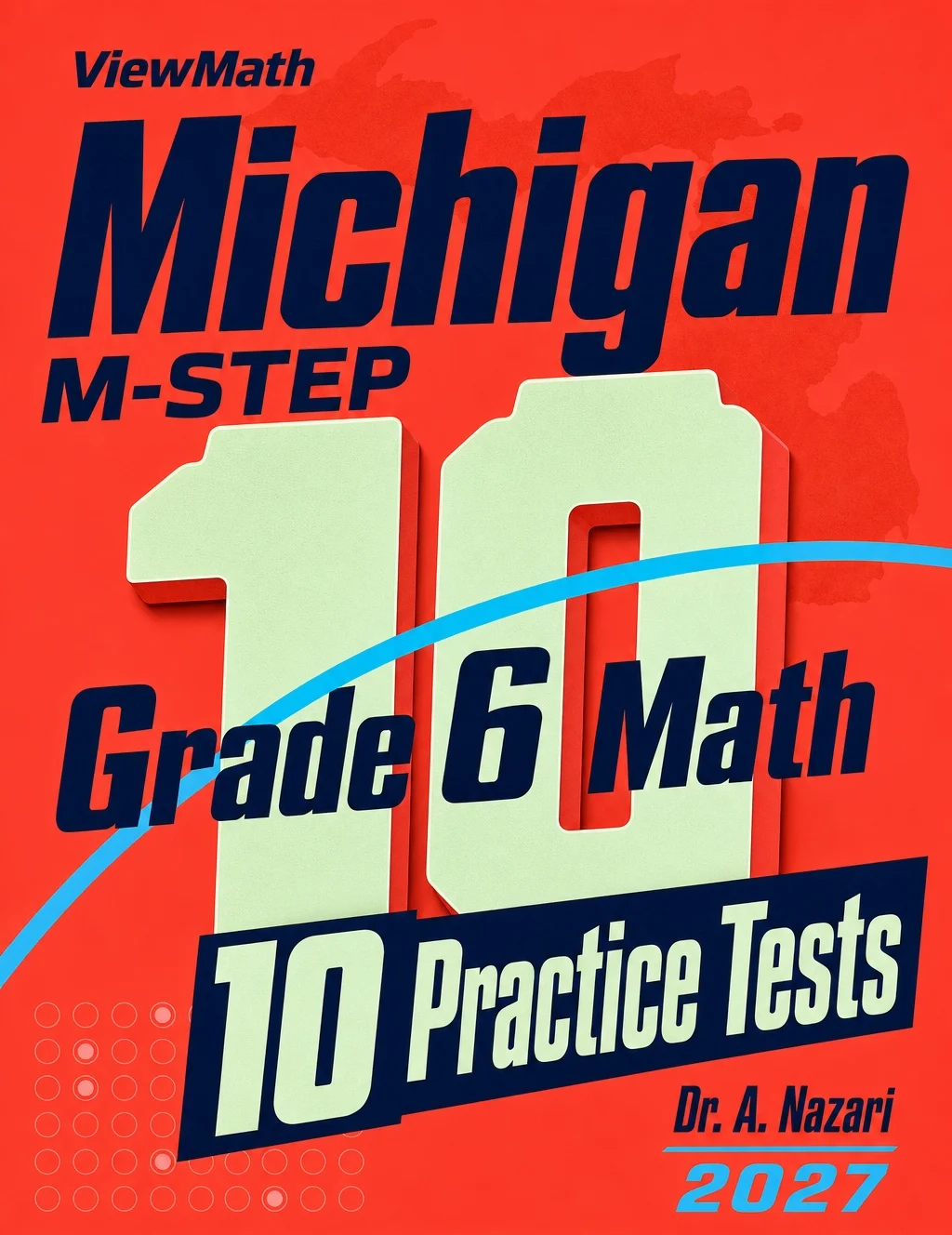
Michigan Grade 6 M-STEP math preparation should start with ratios and rational numbers, then move into expressions, equations, geometry, and statistics. The official Spring 2026 M-STEP online manual lists Grade 6 mathematics as a computer-adaptive test with an estimated 2 hour session time, so students need both skill accuracy and stamina.
ViewMath is not affiliated with or endorsed by the Michigan Department of Education or M-STEP. Confirm current testing windows and rules with your school or the official MDE M-STEP page.
The most productive prep plan is not to reread every lesson from the year. Start with a quick diagnostic, identify the two or three weakest domains, and then use short mixed sets so the student practices switching between ratios, negative numbers, equations, geometry, and data. MDE also provides online sample item sets for students and families who want to see official item styles.
Grade 6 M-STEP Math Topics
- Ratios and Proportional Relationships: ratio tables, unit rates, percent problems, and equivalent ratios.
- The Number System: dividing fractions, negative numbers, absolute value, and rational numbers on the coordinate plane.
- Expressions and Equations: variables, equivalent expressions, one-step equations, and inequalities.
- Geometry: area of polygons, surface area, volume, and nets.
- Statistics: distributions, mean, median, range, interquartile range, mean absolute deviation, dot plots, histograms, and box plots.
Start with a 20-Minute Diagnostic
Give the student one problem from each major topic before starting a long review. The goal is not a score; the goal is to decide where the next week should go.
- Make a ratio table for 4 cups of juice concentrate mixed with 10 cups of water. How much water is needed for 14 cups of concentrate?
- Find 3/4 ÷ 2/3.
- Order -2.5, -1, 0, and -3 from least to greatest.
- Solve x – 7 = 18.
- Find the area of a parallelogram with base 11 cm and height 6 cm.
- The data set is 4, 6, 7, 10, 13. Find the median and range.
If ratios or rational numbers are weak, fix those first. They feed into percent problems, coordinate-plane work, and many word problems. If algebra is weak but arithmetic is strong, add daily equation practice. If geometry formulas are the issue, make a formula card and use it until the student can choose the correct formula without prompting.
Four-Week Prep Plan
| Week | Focus | What to Do |
|---|---|---|
| 1 | Ratios, rates, and percents | Build ratio tables, find unit rates, convert between fractions/decimals/percents, and solve percent-of problems. |
| 2 | Number system | Divide fractions, plot rational numbers, compare negative numbers, and practice coordinate-plane questions. |
| 3 | Expressions, equations, and geometry | Evaluate expressions, solve one-step equations, use inequalities, and review area, volume, nets, and surface area. |
| 4 | Statistics and mixed review | Analyze dot plots, histograms, box plots, center/spread measures, then take two timed mixed practice sets. |
A Simple Weekly Routine
- Monday: 15 minutes of direct review and 10 targeted problems.
- Tuesday: Correct Monday’s missed problems, then solve 10 similar problems with new numbers.
- Wednesday: Mixed practice from two older topics so skills do not fade.
- Thursday: Word problems only. Underline the question, define the quantity, and write the equation or ratio table.
- Friday: Short timed set, followed by an error log.
- Weekend: Rest or do one low-pressure review page. Do not turn every day into a full test.
Sample Grade 6 Practice Set
- A recipe uses 3 cups of oats for 12 muffins. How many cups are needed for 20 muffins at the same rate?
- Find 2/3 ÷ 4/5.
- Order from least to greatest: -3, 2, -1, 0.
- Evaluate 4x – 7 when x = 6.
- Solve y + 9 = 24.
- A triangle has base 14 cm and height 9 cm. Find its area.
- The data set is 5, 7, 7, 9, 12. Find the mean and median.
- A rectangular prism is 6 in. by 4 in. by 3 in. Find its volume.
- A store marks a $45 backpack down by 20%. What is the sale price?
- Plot the point (-4, 3). Which quadrant is it in?
- Simplify 3(2x + 5) – 4x.
- A box has length 8 cm, width 5 cm, and height 3 cm. Find its surface area.
Worked Answers
- 5 cups. The rate is 1 cup for 4 muffins, so 20 muffins need 5 cups.
- 5/6. Multiply by the reciprocal: 2/3 × 5/4 = 10/12 = 5/6.
- -3, -1, 0, 2.
- 17.
- y = 15.
- 63 square cm. Area = 1/2 × 14 × 9.
- Mean = 8; median = 7.
- 72 cubic inches.
- $36. A 20% discount leaves 80% of the price, and 0.80 × 45 = 36.
- Quadrant II. The x-coordinate is negative and the y-coordinate is positive.
- 2x + 15. First distribute to get 6x + 15 – 4x.
- 158 square cm. Surface area = 2(8 × 5) + 2(8 × 3) + 2(5 × 3) = 80 + 48 + 30.
Grade 6 Mistakes to Fix Early
- Part-to-part vs. part-to-whole: A ratio of 3 red to 5 blue is not the same as 3 out of 5 total.
- Fraction division without meaning: Students may flip the wrong fraction if they do not rewrite the expression carefully.
- Negative number order: Numbers farther left on the number line are smaller.
- Statistics vocabulary: Mean, median, range, IQR, and MAD answer different questions about data.
- Formula picking: Area, volume, and surface area are different questions. Students should write the formula name before substituting numbers.
- Distributing too quickly: In 3(2x + 5), both terms inside the parentheses must be multiplied by 3.
How to Review Missed Problems
After every practice set, sort missed problems into four labels: concept, calculation, reading, or time. A concept mistake means the student needs a short lesson. A calculation mistake means the method was right but fluency needs work. A reading mistake means the student skipped a condition, unit, or comparison word. A time mistake means the student may need more estimation and pacing practice.
For Grade 6, the error log should be specific. Instead of writing “fractions,” write “divided by the first fraction instead of multiplying by reciprocal.” Instead of “geometry,” write “used perimeter when the question asked for area.” Specific error logs turn review into a plan.
ViewMath Michigan Grade 6 Resources
Use ViewMath Michigan Grade 6 M-STEP resources for topic review, workbooks, quizzes, and full practice tests. A workbook is best for rebuilding weak topics. A practice-test book is best once the student can handle mixed review and needs timing, stamina, and error-log practice.
Recommended ViewMath Books