Families often search for “Michigan Algebra 1 M-STEP prep” when they want focused review for Algebra 1 skills, district end-of-course checks, or high school math readiness. It is important to use the phrase carefully. The Michigan Department of Education M-STEP page describes M-STEP as Michigan’s statewide standards-based assessment program, and the official assessment calendar page is the right place to confirm current grade-level and high school testing requirements. Michigan high school assessment requirements can involve the MME, SAT with Essay, science, social studies, and other components depending on grade and program, so families should not assume that every Algebra 1 course has the same statewide EOC format.
This guide gives students an EOC-style Algebra 1 review plan that fits Michigan standards-based instruction: equations, functions, graphing, systems, polynomials, quadratics, data, and modeling. Use it for final exams, placement review, accelerated Grade 8 Algebra 1, Grade 9 Algebra 1, tutoring, or general M-STEP-style skill strengthening.
ViewMath is not affiliated with or endorsed by the Michigan Department of Education, M-STEP, MME, College Board, or any Michigan school district. Always confirm official test requirements, administration windows, and accommodation rules through MDE and your local school.
What Michigan Algebra 1 Students Should Be Able to Do
A strong Algebra 1 review plan should move beyond memorizing procedures. Students need to read a situation, choose the right representation, and explain what a number means in context. That means a good practice set should rotate among equations, tables, graphs, verbal descriptions, and word problems.
| Algebra 1 Skill | What Students Should Practice | Quick Check |
|---|---|---|
| Linear equations | Solving multi-step equations, variables on both sides, equations with fractions, and literal equations | Can the student solve 3(x – 4) = 2x + 9 and check the answer? |
| Functions and graphs | Function notation, rate of change, intercepts, increasing/decreasing intervals, and comparing representations | Can the student explain what f(5) means in a real-world problem? |
| Systems | Graphing, substitution, elimination, and interpreting one solution, no solution, or infinitely many solutions | Can the student decide when substitution is faster than elimination? |
| Polynomials | Adding, subtracting, multiplying, factoring, and recognizing structure | Can the student factor x2 + 7x + 12 without guessing wildly? |
| Quadratics | Graphing parabolas, finding zeros, using factored form, vertex form, and the quadratic formula | Can the student connect x-intercepts to solutions? |
| Modeling | Writing equations from scenarios, interpreting slope and intercepts, and choosing linear vs. exponential models | Can the student explain the units attached to a slope? |
A 4-Week Michigan Algebra 1 Review Plan
This plan works for end-of-course review, district finals, summer review before Algebra 2, or targeted practice before a standards-based assessment. Students who are very behind should stretch it to six weeks; students who are already strong can compress it into two focused review weeks.
Week 1: Linear Equations, Inequalities, and Graphing
- Day 1: Solve one-step, two-step, and multi-step equations.
- Day 2: Solve equations with variables on both sides and check solutions.
- Day 3: Graph lines from slope-intercept form and standard form.
- Day 4: Write equations from two points, a graph, and a word problem.
- Day 5: Mixed review: 20 linear problems with an error log.
Week 2: Systems and Functions
- Practice graphing systems and estimating the point of intersection.
- Use substitution for systems where one equation is already solved for a variable.
- Use elimination when coefficients line up or can be made to line up quickly.
- Review function notation, domain, range, and comparing functions in different forms.
- End the week with 10 word problems that require writing a system or function rule.
Week 3: Polynomials, Factoring, and Quadratics
- Multiply binomials and simplify polynomial expressions.
- Factor greatest common factors, trinomials, and difference of squares.
- Solve quadratic equations by factoring and by the quadratic formula.
- Graph quadratics and identify zeros, vertex, axis of symmetry, and y-intercept.
- Translate between standard form, factored form, and a graph when possible.
Week 4: Modeling, Data, and Mixed Practice
- Compare linear, quadratic, and exponential patterns from tables and graphs.
- Review scatter plots, lines of fit, residual thinking, and interpreting data in context.
- Take one timed mixed practice test.
- Spend two days correcting mistakes by topic, not just by problem number.
- Finish with a short confidence set: 15 problems the student should now be able to solve accurately.
Sample Algebra 1 Practice Questions
Use these as a quick diagnostic before choosing the first review topic.
- Solve: 4(x – 3) + 7 = 2x + 15
- A line passes through (2, 5) and (6, 17). Find its slope and write an equation in slope-intercept form.
- Solve the system: 2x + y = 11 and x – y = 1
- Factor: x2 + 9x + 20
- Solve: x2 – 5x – 14 = 0
- A gym charges a $30 sign-up fee plus $18 per month. Write a function for total cost after m months and find the cost after 8 months.
Answer Key
- 4x – 12 + 7 = 2x + 15, so 4x – 5 = 2x + 15, 2x = 20, and x = 10.
- Slope = (17 – 5) / (6 – 2) = 3. Using y = mx + b with (2, 5), 5 = 3(2) + b, so b = -1. Equation: y = 3x – 1.
- Add the equations: 3x = 12, so x = 4. Then 4 – y = 1, so y = 3. Solution: (4, 3).
- x2 + 9x + 20 = (x + 4)(x + 5).
- x2 – 5x – 14 = (x – 7)(x + 2), so x = 7 or x = -2.
- C(m) = 30 + 18m. C(8) = 30 + 144 = 174 dollars.
How to Choose the Best ViewMath Algebra 1 Resource
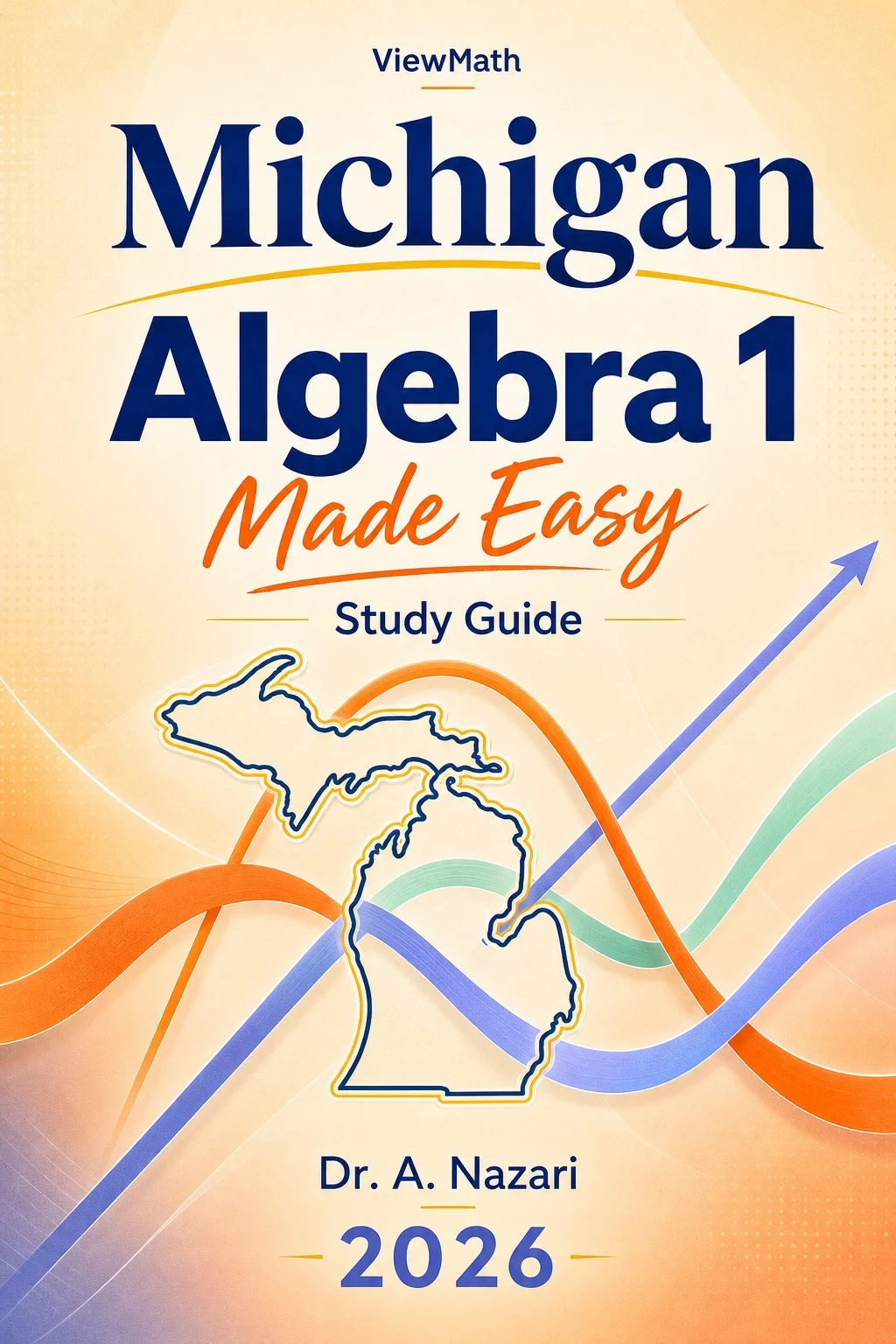
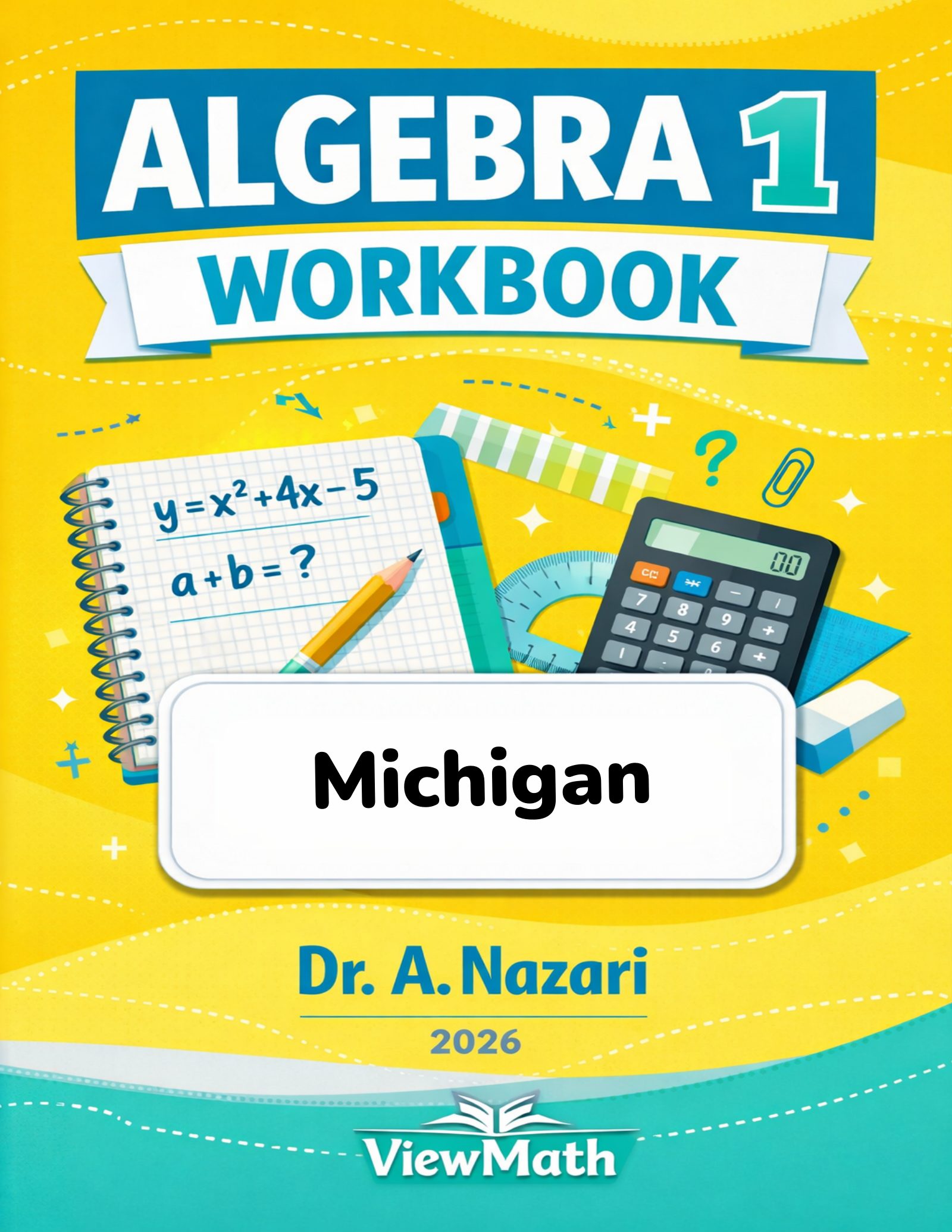
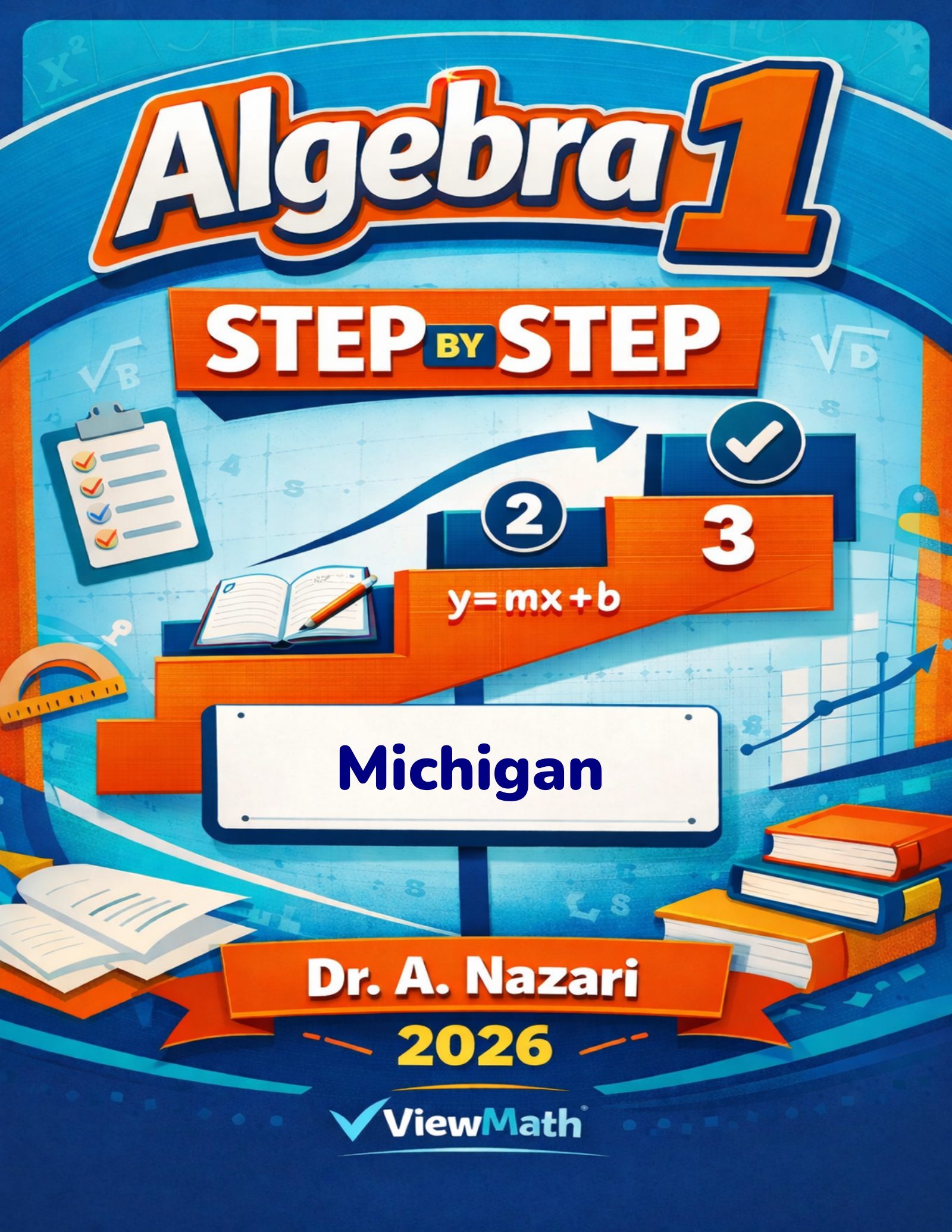
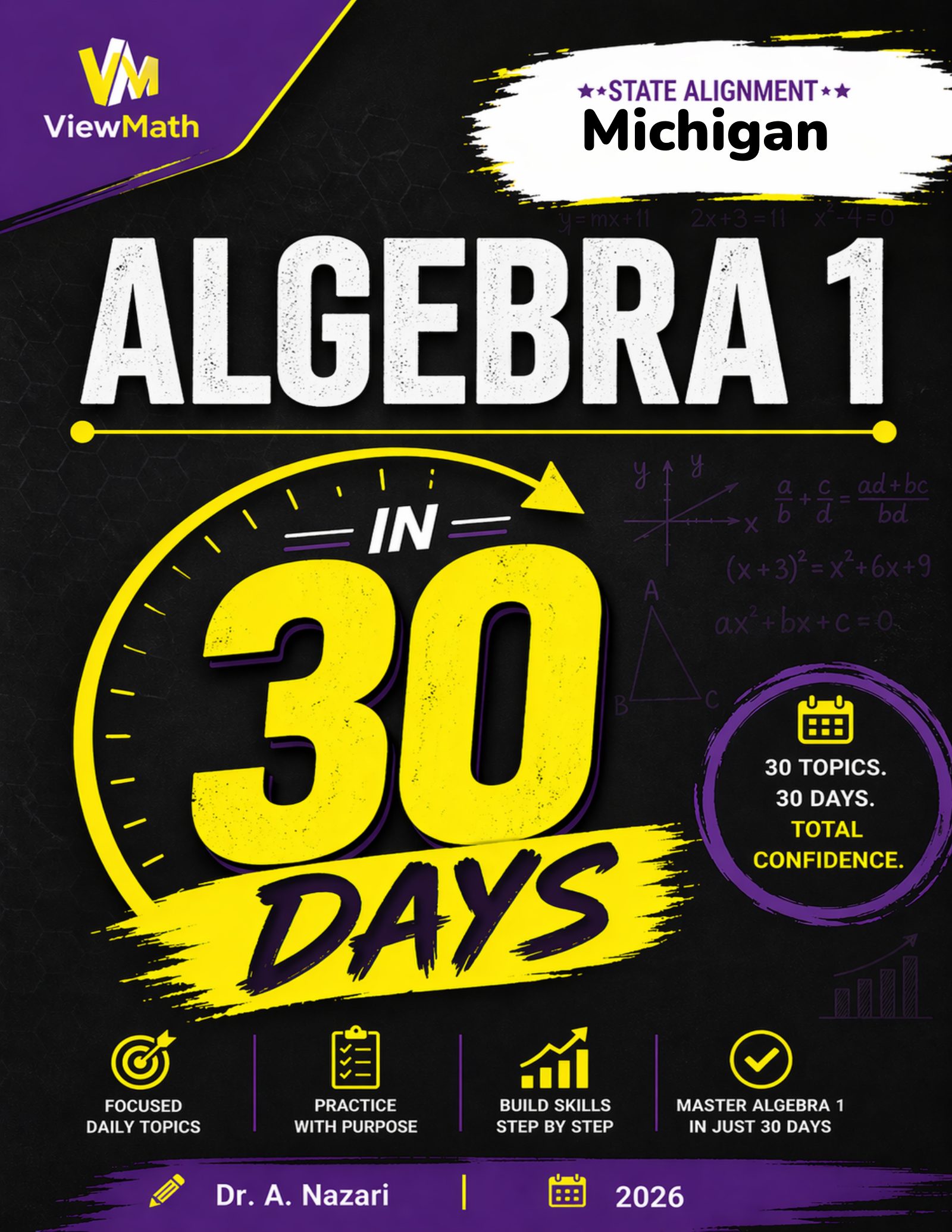
For students who need instruction and examples, start with the Michigan Algebra 1 study guide or workbook. For students who already know the content but need speed and stamina, choose practice tests. For students who have one month left before a final or placement check, the 30-day review book is usually the most efficient option.
- Study guide: Best when the student needs step-by-step explanations before practice.
- Workbook: Best for building fluency through repeated topic practice.
- Practice tests: Best for mixed review, pacing, and identifying weak areas.
- 30-day plan: Best for families who want a daily schedule without planning each lesson.
- Quiz book: Best for short tutoring sessions and progress checks.
The goal is not to label every practice problem as “M-STEP” or “EOC.” The goal is to build the Algebra 1 skills that Michigan math courses and standards-based assessments expect students to use flexibly.
Recommended ViewMath Books